 ADNAN ASSOCIATES
Guide
How payments work when we build your home
Last reviewed 18 November 2026
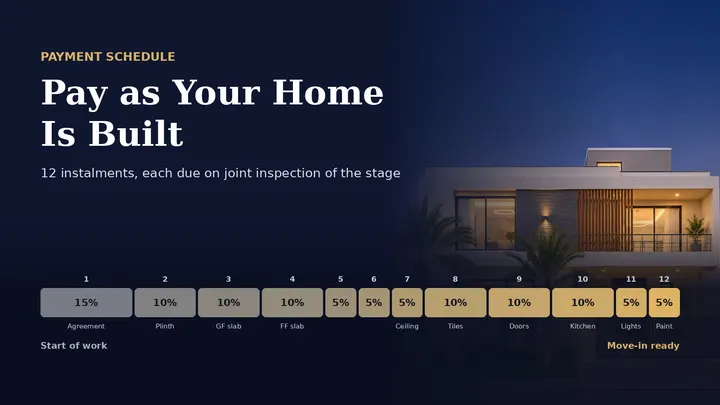
Building a house is usually the largest payment a family makes, and one of the biggest worries is paying a builder too much, too early. In our quotations you do not pay the whole amount up front. Payment follows the progress of the building: 12 instalments, each due on joint inspection of the stage. That means you and our team look at the work together before the next payment is asked for.
This guide explains how the schedule works, what each stage covers, how much of the total falls due at each point, and how we handle material price rises, changes to the scope and defects after handover.
Why stage-linked payments protect you
Many construction disputes in Karachi start the same way: a large advance is paid, work slows down, and the owner has no leverage left. A stage-linked schedule avoids this:
- You pay for work that exists. After the first instalment at agreement, every payment is linked to a stage you can see and inspect.
- Your money and the building move together. At no point have you paid far ahead of the work on site.
- Quality is checked before you pay. Because each instalment follows a joint inspection, problems are raised and fixed while the stage is still open, not after it is covered by the next one.
- You can plan your cash flow. You know in advance what share of the total falls due at each stage, so you can arrange funds in time.
How each instalment works
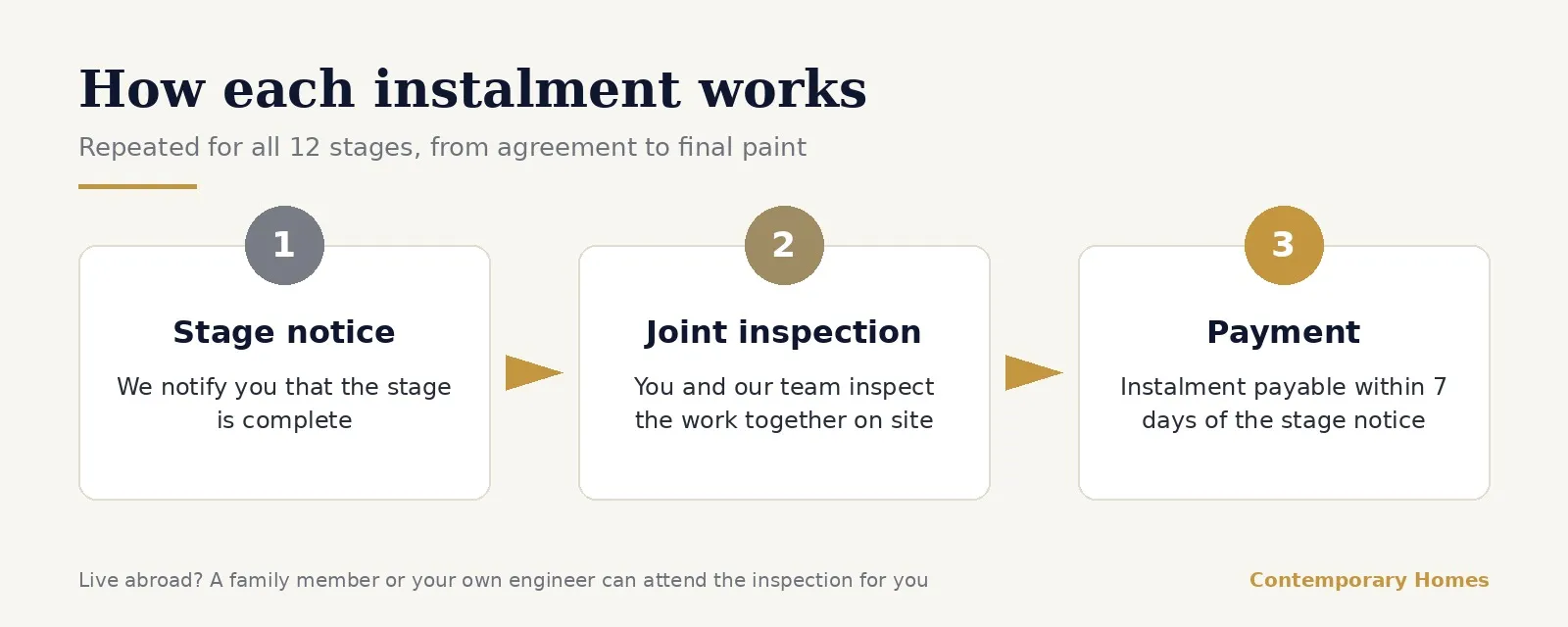
Every instalment follows the same three steps:
- Stage notice. When a stage is complete, we send you a stage notice.
- Joint inspection. You (or someone you nominate) and our team inspect the completed stage together on site.
- Payment. The instalment is payable within 7 days of the stage notice.
If you live abroad or cannot visit, you can nominate a family member or your own engineer to attend the inspection on your behalf.
The 12 stages and what you pay at each
| # | Stage | Share | Paid to date |
|---|---|---|---|
| 1 | At agreement | 15% | 15% |
| 2 | Plinth | 10% | 25% |
| 3 | Ground-floor slab | 10% | 35% |
| 4 | First-floor slab | 10% | 45% |
| 5 | External plaster | 5% | 50% |
| 6 | Internal plaster | 5% | 55% |
| 7 | False ceiling, primer and plumbing | 5% | 60% |
| 8 | Tiles and stair steps | 10% | 70% |
| 9 | Wardrobes and doors | 10% | 80% |
| 10 | Kitchen and washroom fixtures | 10% | 90% |
| 11 | Railing and lights | 5% | 95% |
| 12 | Final paint and completion | 5% | 100% |
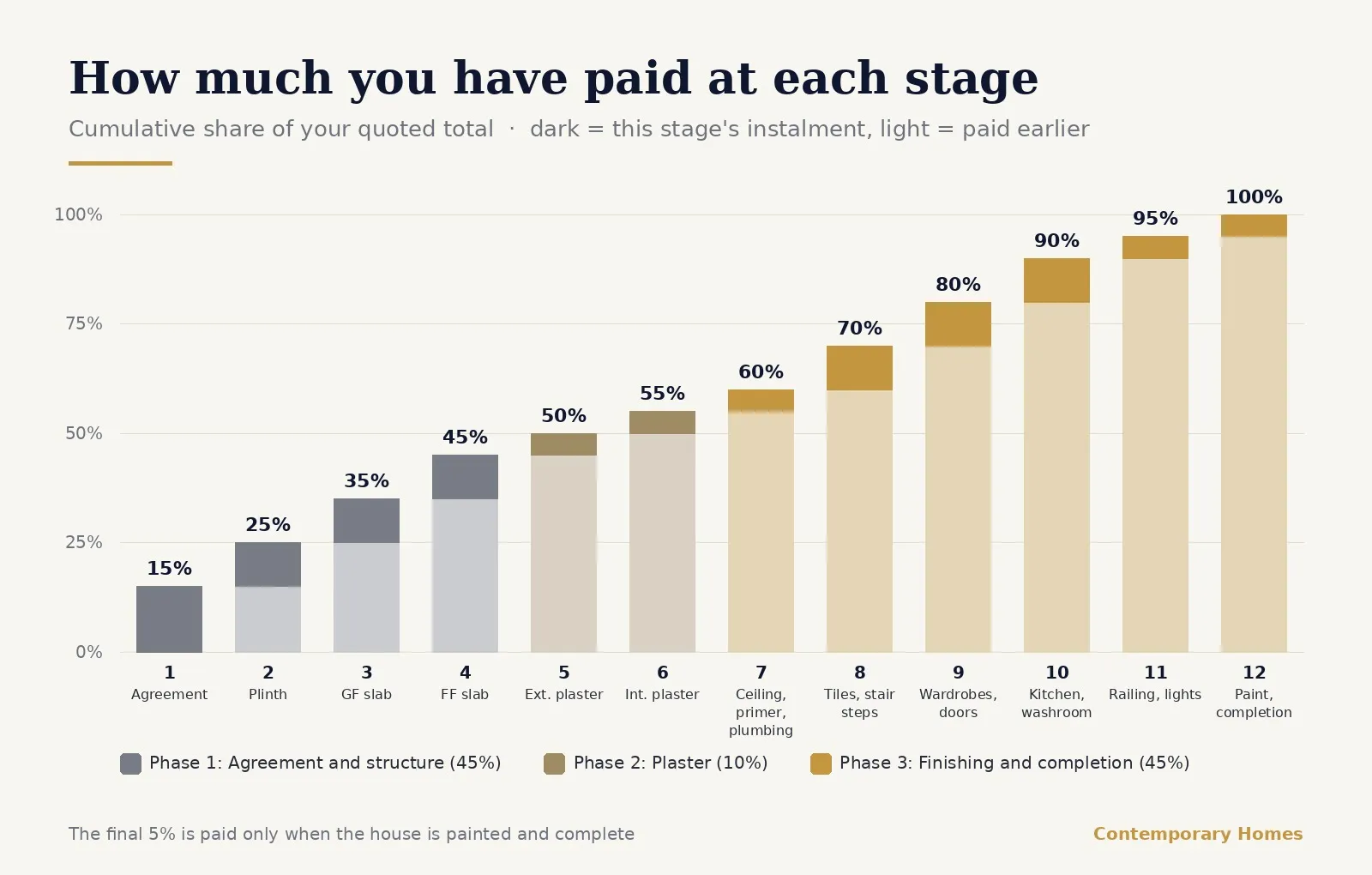
The schedule falls into three phases.
Phase 1: Agreement and structure (stages 1 to 4, 45%)
The first instalment, 15% at agreement, mobilises the project: the site is set up and materials for the foundations are ordered. The next three instalments follow the main structural milestones: the plinth, the ground-floor slab and the first-floor slab. These are the stages where concrete and steel go in, and where careful inspection matters most, because they cannot be changed later.
Phase 2: Plaster (stages 5 and 6, 10%)
Once the frame and walls are up, the building is plastered: external plaster first, then internal plaster. At the end of this phase the house is closed and ready for finishing, and you have paid 55% of the total.
Phase 3: Finishing and completion (stages 7 to 12, 45%)
The last six instalments follow the finishing work, in the order it happens on site:
- False ceiling, primer and plumbing
- Tiles and stair steps
- Wardrobes and doors
- Kitchen and washroom fixtures
- Railing and lights
- Final paint and completion
The final 5% is paid only when the house is painted and complete, so the last instalment is linked to a finished home.
An example: how the instalments add up
The shares apply to your own quoted total. To show how they work, here is the schedule on an example total of PKR 10,000,000 (one crore). This is an illustration only, not a price.
| # | Stage | Share | Instalment (PKR) |
|---|---|---|---|
| 1 | At agreement | 15% | 1,500,000 |
| 2 | Plinth | 10% | 1,000,000 |
| 3 | Ground-floor slab | 10% | 1,000,000 |
| 4 | First-floor slab | 10% | 1,000,000 |
| 5 | External plaster | 5% | 500,000 |
| 6 | Internal plaster | 5% | 500,000 |
| 7 | False ceiling, primer and plumbing | 5% | 500,000 |
| 8 | Tiles and stair steps | 10% | 1,000,000 |
| 9 | Wardrobes and doors | 10% | 1,000,000 |
| 10 | Kitchen and washroom fixtures | 10% | 1,000,000 |
| 11 | Railing and lights | 5% | 500,000 |
| 12 | Final paint and completion | 5% | 500,000 |
| Total | 100% | 10,000,000 |
For your actual figures, use the cost calculator, which shows the instalments for your plot size.
If material prices rise
Cement, steel and other material prices in Pakistan can move during a project that runs for many months. Our quotations state clearly who carries that risk:
- Rises of up to 5% are absorbed by the contractor. You pay nothing extra.
- Above 5%, the owner pays the difference, and only on materials that are still to be bought. Materials already purchased for completed stages are never re-priced.
This keeps the quotation fair on both sides: you are protected from normal price movement, and you are never charged again for work that is already done.
If an instalment is delayed
The schedule works because payment and progress move together. If an instalment is not paid within 7 days of the stage notice, work on the next stage may be delayed, and any resulting increase in cost is borne by the owner.
No silent changes
Plans often change once building starts. You may want a different tile, an extra cupboard or a changed layout. We handle every change the same way:
- Any change to the agreed scope is a written variation.
- The variation shows the price difference and the effect on time, so you can see exactly what the change means before you approve it.
- Nothing is substituted without your written approval. No material, brand or item in your quotation is swapped quietly for something else.
After handover
We give 12 months defects liability on workmanship after handover. If a defect in our workmanship appears during that period, we come back and fix it.
Questions to ask any builder about payment
Before you sign with any builder, ask:
- How much is paid at agreement? A very large advance leaves you with little protection.
- Is each payment linked to a stage you can inspect? Or is it linked to dates on a calendar?
- Who carries material price rises, and above what limit? Is the limit written in the contract?
- How are changes priced? Ask for written variations showing cost and time.
- Can materials be substituted without your approval?
- What defects liability is given after handover, and for how long?
For a full list, read our checklist before you sign.
Frequently asked questions
Do I have to pay the full construction cost in advance?
No. You pay 15% at agreement. The rest is paid in 11 further instalments, each linked to a completed stage.
What is a joint inspection?
At the end of each stage, you (or someone you nominate) and our team inspect the completed work together on site before the next payment is asked for.
How long do I have to pay each instalment?
Each instalment is payable within 7 days of the stage notice.
How much will I have paid when the structure is complete?
After the first-floor slab (stage 4) you will have paid 45% of the total, and after internal plaster (stage 6), 55%.
What happens if cement or steel prices go up?
The contractor absorbs material price rises of up to 5%. Above that, the owner pays the difference, only on materials that are still to be bought.
Can I change the design or materials after signing?
Yes. Every change is recorded as a written variation showing the price difference and the effect on time, and nothing is substituted without your written approval.
Is there a warranty after handover?
We give 12 months defects liability on workmanship after handover.
See your own schedule
The shares above apply to your quoted total, whatever your plot size. Use the cost calculator to see the instalments for your plot, or message us on WhatsApp for a detailed quotation.
Have a question about your plot?
Message us on WhatsApp and we will answer in plain words.